Quantum in the Mountains: How Washington and Lee University Scales the Research Frontier with a Team of One
By leveraging national infrastructure and desktop quantum computing, W&L is proving that small liberal arts colleges can lead in high-level computational discovery.
Located in the historic town of Lexington, Virginia, Washington and Lee University (W&L) is a private liberal arts institution known for its rigorous academics and unique teaching-first mission. CaRCC spoke with Tom Marcais, Research Computing Administrator at W&L’s Research Computer and Data (RCD) program, to learn how a “team of one” leverages national cyberinfrastructure and a desktop quantum computer to bridge the gap between scientific intuition and computational reality.
The following Q&A has been edited for brevity and clarity.
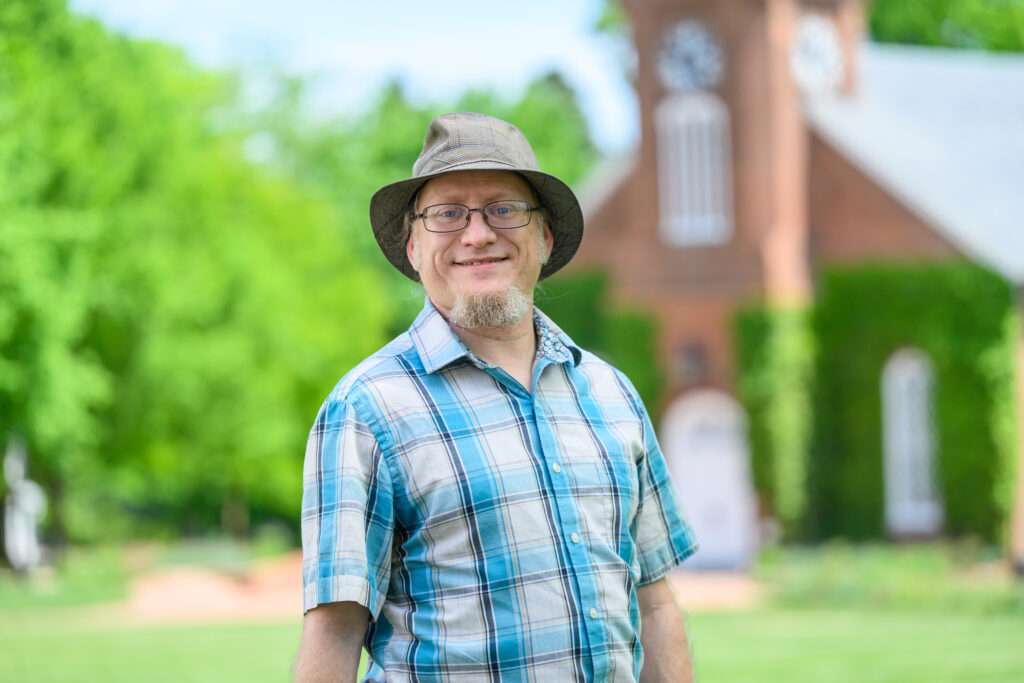
Tom Marcais, Research Computing Administrator, W&L’s RCD program
How did research computing first take root at Washington and Lee?
When I arrived over 10 years ago to support technology in the sciences, there was no dedicated support for research computing. It became clear very quickly that faculty had a strong desire for technical guidance and access to resources, but implementing solutions on their own was challenging. Early efforts focused on Amazon Web Services (AWS), but we ran into cost hurdles. Our Chief Information Officer (CIO), David Saacke, encouraged me to explore the Extreme Science and Engineering Discovery Environment (XSEDE) after hearing about it through the Consortium of Liberal Arts Colleges (CLAC). Becoming an XSEDE Campus Champion—now part of the Advanced Cyberinfrastructure Coordination Ecosystem: Services & Support (ACCESS) program—opened the door to national infrastructure that would otherwise have been out of reach. It helped legitimize research computing as a formal service area within W&L’s Information Technology Services (ITS).
What does your recent transition to a dedicated RCD role signify for the university?
It’s a significant milestone. In the small liberal arts ecosystem, research computing was often just a fraction of an overall workload. This promotion marks the first time our institution has made a formal commitment to RCD as a dedicated position. It shows that in a 10-year span, we moved from a siloed presence to having RCD recognized as an institutional priority. While I am still a team of one with great support from our broader ITS department, my job description now explicitly includes growing the RCD program. I suspect within the next five years we will justify additional positions as faculty continue to incorporate student projects into their curriculum that relies on high-level computing.
You’ve described your role as a “librarian of resources.” How does that shape your work?
A librarian needs to know what books and articles are available across a vast network; likewise, I need to stay current on technologies and translate a researcher’s scientific intuition into a technical solution. At a school of our size, about 1,900 undergraduate students, plus nearly 400 Juris Doctor (JD) law students—the missing piece isn’t raw compute power. There are ample national resources out there. The gap is the person who can demystify the process. Most faculty assume these national resources are too bureaucratic to pursue, but once you make the connections, they realize they can do science they never thought possible.
How does W&L’s teaching mission change how you design RCD services?
At a liberal arts institution, the boundary between research and teaching is genuinely porous. Our Posit Workbench and Posit Connect servers (software for R and Python development) support hundreds of students each semester as part of their coursework. They arrive at research projects already familiar with the tools. Also, because our faculty have heavy teaching loads, their “research windows” are very narrow, often just two or three months in the summer. They can’t afford to spend the first month figuring out a new system. I spend a lot of time configuring “a custom turnkey” environment setup in advance, so when a researcher logs in, the system is already tuned for their specific workflow.
Who are your primary users, and are you seeing interest from non-traditional disciplines?
STEM disciplines like biology and geology generate the most consistent demand, but the Data Science Program is now one of our largest interdisciplinary programs, spanning into our commerce and business schools. One fascinating project involves a member of our law faculty investigating the ethical risks of Large Language Models (LLMs) in legal practice.
Most law firms avoid the cloud due to privacy concerns, opting instead for local AI instances. However, these installations can “learn” word-weightings across multiple client files, potentially causing sensitive information to leak from one matter to another. This “data bleed” violates core legal ethics, requiring strict firewalls to be maintained between conflicting cases.
By leveraging Jetstream2’s powerful GPU instances, this project uses synthetic data to test DeepSeek and other locally installable models. The goal is to see how far these word-weightings propagate: do they spill across folders, accounts, or even up to the parent LLM level? By using standard analytic methods to track these patterns, the research aims to prove whether local installations can truly provide the security firewalls needed to protect client data.
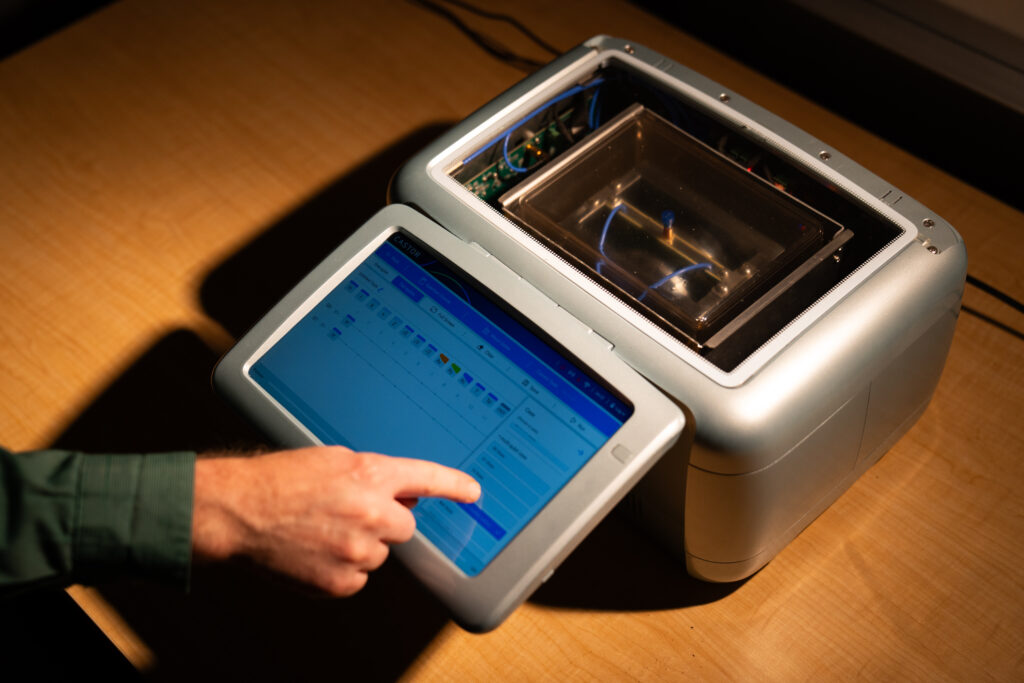
The SPINQ Gemini Mini 2-qubit Portable NMR Quantum Computer, a.k.a. “Toaster Oven,” from China.
How did a desktop quantum computer, nicknamed “Toaster Oven,” end up on campus?
It started with a spark in 2019 when I was on the board of the Association Supporting Computer Users in Education (ASCUE) Annual Conference, and grew into a full-course offering: Physics 190: Foundations of Quantum Computing. In 2023, we purchased a desktop quantum computer—a SpinQ machine built in China—which is reaching students who never imagined themselves in computing. We have an english major considering a physics double major because of it, and a politics major exploring the intersection of quantum computing and political philosophy. One of our students, Zihan Li, even presented a poster at the American Physical Society national conference on a quantum algorithm. Bringing this cutting-edge technology to students is exactly what research computing at a liberal arts institution should do.
Are your undergraduate students able to effectively learn such a complex topic as Quantum Computing?
While our 2-qubit system is unlikely to produce groundbreaking research, it has proven to be an excellent teaching tool. One of my favorite moments came shortly after we received the unit. Because it has no video output, we used a document camera to display results on the classroom screen. The built-in simulations behaved exactly as expected. However, when we switched to running the same algorithms on the actual qubits, the results suddenly made no sense.
At first, we suspected a hardware issue. Then one student, recalling our earlier discussions, asked, “Could electromagnetic interference from the document camera be affecting the qubits?” We removed the camera, and the algorithms ran flawlessly. It was a proud teaching moment, and one that simply would not have been possible without hands-on access to a physical quantum computer.
Do you use any cloud-based services or any other resources for the quantum computer?
We do use some cloud-based services for quantum computing. Most of our work so far has been on the IBM Quantum Platform. In addition, we have worked with Black Opal and Classiq for potential use in future classes. I was introduced to Classiq by Dr. Erik Garcell at the PEARC ’25 conference, and I believe it has significant potential for our students. Its ability to build quantum software at the algorithm level, using natural language AI assistance rather than gate-level circuits, could make quantum development much more accessible. It also provides tools to compile and optimize code, as well as recompile it to run efficiently across different quantum hardware platforms and simulators. They currently provide free access for non-commercial use, making it an ideal solution for our coursework.
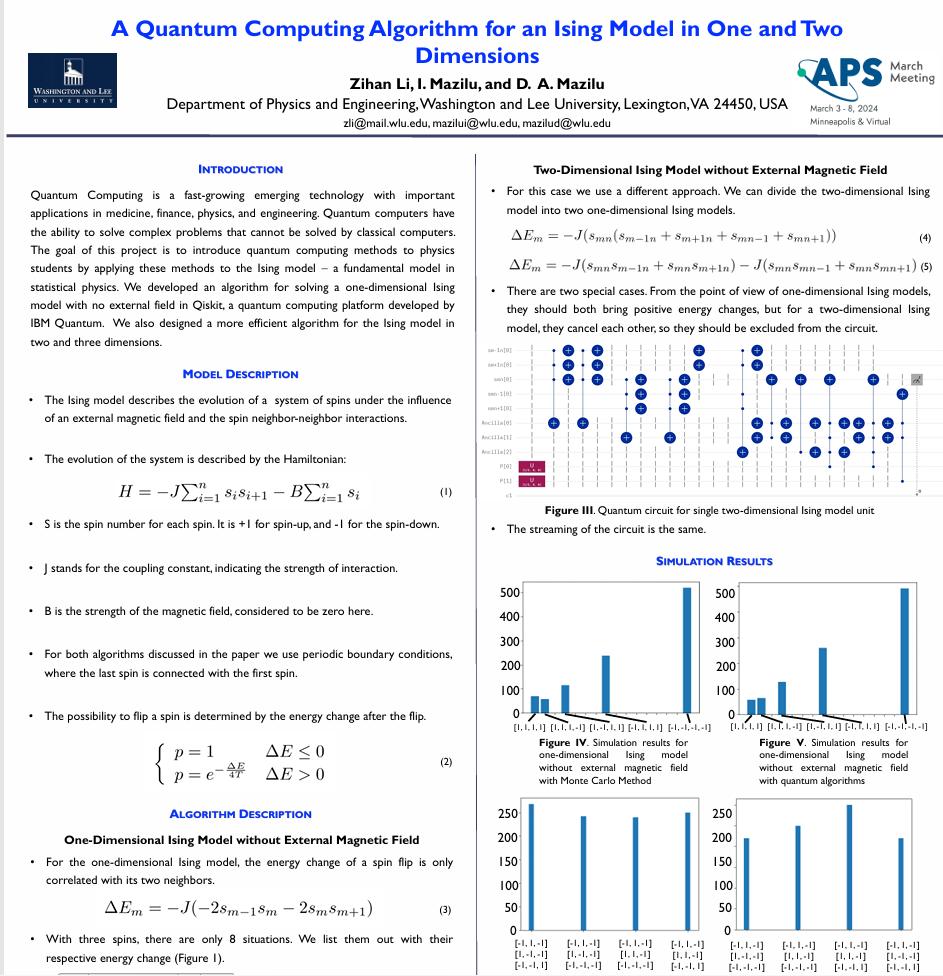
A poster on a quantum algorithm presented by W&L student, Zihan Li at an American Physical Society national conference.
How close do you think we are to seeing quantum computing as a standard research tool?
I think of quantum computing as another accelerator in our toolbox, much like a Graphics Processing Unit (GPU). It won’t make every problem faster, but it could be incredibly efficient for complex systems like drug discovery or financial market analysis. Experts once said we wouldn’t see results until 2040, but the timeline is moving up rapidly. It’s why I’m helping to create a CaRCC Affinity Group on Quantum Computing—we need to be ready.
Creativity seems to be a requirement for a one-person program. How do you handle funding and hardware gaps?
Creativity is not optional. When a researcher needed to run a memory-intensive genomic workflow that took 45 days, we repurposed a decommissioned server rather than buying new hardware. Recently, I installed two older graphics cards in a retired workstation to run a small-parameter AI model. These aren’t “glossy” solutions, but they reflect our approach: finding value in what others have written off. We also lean heavily on ACCESS allocations, which provide pre-funded national compute resources, at no cost to us, for qualifying research and teaching activities.
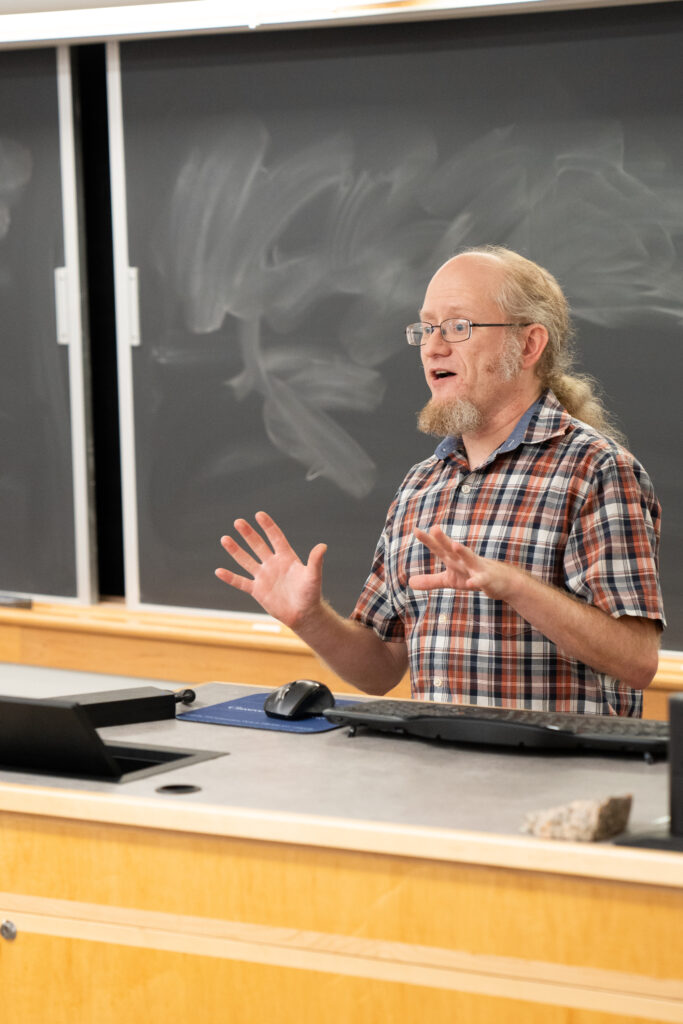
A “teachable moment” with Tom
What advice would you give to others starting RCD support at smaller institutions?
First, start by listening. Understand where faculty are stuck; often, the bottleneck is the technical skill set, not raw power. Second, don’t build everything locally. National resources like ACCESS exist for institutions like ours. Third, be visible—an office near the faculty makes all the difference. Finally, find a peer community. Organizations like CaRCC, Campus Champions, and Research Computing at Smaller Institutions (RCSI) connect you with people solving these exact problems. You don’t have to figure it out alone.
What is your elevator pitch for the program?
The program helps W&L researchers do science they could not do otherwise. Whether that means running a genomics workflow on a national supercomputer, building a machine learning model in the cloud, or executing an algorithm on an actual quantum computer, the goal is to bridge the gap between ambitious research ideas and the computational infrastructure needed to realize them. At a liberal arts institution, that also means bringing these capabilities into the classroom, so students leave with fluency in the tools shaping the future of discovery.
As Tom transitions into his role as research computing administrator, the story of W&L serves as a blueprint for smaller institutions: that with a bit of resourcefulness, a “librarian” mindset, and perhaps a brave-(not-so)-little-toaster machine, even the smallest team can reach the frontier of global research.
If you are interested in learning more about the CaRCC Affinity Group on Quantum Computing, please check the website for upcoming events.