

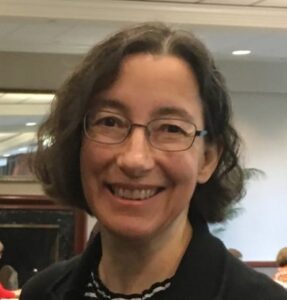
As CaRCC celebrates its tenth anniversary year, Stephanie Heidemann spoke with Dana Brunson, co-founder and chair of the transitional board of CaRCC, about the last ten years, the growing pains of building an organization and its transition into nonprofit status, and looking ahead for CaRCC.
Dana Brunson earned her PhD in mathematics from the University of Texas at Austin before pivoting into research computing and data (RCD), where she eventually became the director of the high-performance computing center at Oklahoma State University. Today, she serves as executive director for research engagement at Internet2, where she leads a team advancing research cyberinfrastructure nationally and plays a supportive role in the National AI Research Resource (NAIRR). Along the way, she co-founded CaRCC’s People Network with Lauren Michael and now chairs the organization’s transitional board as it moves toward a nonprofit status. We sat down with her to look back at CaRCC’s founding and how it has grown into a national community that has reshaped how the RCD profession sees—and names—itself.
What was your role when you first got involved with CaRCC?
I came in as a participant in the original group that formed around the NSF grant that founded CaRCC—Jim Bottum was the original PI. There were maybe a dozen or twenty people from different institutions in the early days, and the idea was to create a space for workforce development and experience-sharing for people in the RCD field, which was really just emerging as a profession at the time.
Out of that, a set of goals took shape—workforce development and building what we called, the CaRCC Facilitator Network. Lauren Michael and I were asked to co-chair that effort. We started in October 2017 and launched in January 2018 with what’s still called the Researcher-Facing Track of the People Network today.
The founding group initially planned a paid, institutional-membership model. What changed?
That was the original plan—institutions would pay dues to join. But when Lauren and I started working together in 2018, we both felt strongly that we didn’t want to restrict participation to people whose institutions could afford membership. The rest of the founding group was already deep into planning the institutional-membership structure, but we brought our concerns to everyone and got consensus to pivot toward something much more open and inclusive.
That decision is really where CaRCC’s whole ethos of transparency and shared attribution and credit took root. Tom Cheatham at the University of Utah, our founding chair, held that vision strongly from the start. No matter what any individual working group or document says, that ethos is the thing underneath it all—and it’s what I hope we maintain as the organization keeps growing.
Can you tell us about the People Network and how it grew?
The People Network became the home for this emerging profession—something that hadn’t really existed before. We learned a lot about how professions form from Joel Gershenfeld, an organizational scientist we met early on through a workshop that included people who study exactly that question: how librarians, doctors, lawyers, and other professions came into being. That framing—RCD as an emerging profession—shaped a lot of CaRCC’s early thinking.
The Researcher-Facing Track launched first, in January 2018, giving RCD professionals a dedicated place to talk about facilitation—helping researchers and educators use technology—which was still a fairly new, named practice at the time even though people had been doing versions of that work for decades. We expanded from there into a Systems-Facing Track and other tracks, each with their own volunteer co-chairs.
One thing a stakeholder alignment survey taught us early on: this community doesn’t want barriers to entry. Unlike professions like medicine or law, which require specific degrees and credentials, our community wants to stay open to people who come into the field from all kinds of backgrounds. That value of inclusivity has stuck.
What specific gaps or challenges were you and the founding team trying to solve?
Mostly workforce challenges. Campuses that had research computing programs—or needed to build them—struggled to find people who knew how to do the work, to hire them, and even to define what the work actually was. And once someone got the job, there wasn’t a clear path to learn how to do it well.
I used to say this field requires more knowledge than any single person can hold, so you have to rely on others to learn it. I can’t personally know enough to help a biologist, a humanist, and a physicist all with equal depth—you need a whole network of people to call on. That’s really the two big pieces of CaRCC: the People Network, which is the community and the heart of experience-sharing, and the working groups, which build concrete resources—things like the HR job family framework that’s since been adopted at many institutions, and workforce census data that’s given the field real visibility into who’s doing this work and how.
Looking back, what were some of the unexpected hurdles in formalizing a national identity for RCD professionals?
A lot of it was scaffolding—the unglamorous infrastructure work. Did we have an email list? Shared notes? Was everyone getting notified when something important happened? In the early days, Lauren and I built out our Slack instance and Google Workspace, and we developed a habit of creating extremely thorough meeting notes—to the point that some colleagues have adopted similar practices.
As CaRCC grew, the next big hurdle was coordination—making sure all the working groups and tracks knew enough about what each other was doing that they weren’t duplicating efforts or working at cross-purposes. And more recently, as we’ve matured our governance and started rotating chairs in and out of leadership roles, there’s been a whole new layer of scaffolding: onboarding and offboarding chairs, developing new leaders, and keeping communications running so people feel like they’re still in the loop. Bringing Daphne McCanse on in a communications role several years ago was a big turning point—communications work is often undervalued in this field, and having someone dedicated to it has made a real difference.
How did your own background shape your approach to community building?
A lot of it came from watching how groups work—and don’t work. Like most people, I’d been in plenty of working groups that just spun their wheels for years without accomplishing much. What made CaRCC different, I think, was learning from Joel Gershenfeld how to actually get a group moving. We ran stakeholder alignment surveys to find out what people genuinely cared about getting done, which let us prioritize—and the original CaRCC working groups came directly out of that process. Joel also modeled how to facilitate a working group, and a lot of us learned that facilitation—of groups, not just of research—a skill you can actually learn. Many of us went and read books on community organizing and conflict management and tried to put that into practice, and then teach it to others.
The deeper root of it, though, goes back to when I was new to HPC and had to Google my way through problems that had zero search results—I had to ask people directly, and the community was incredibly generous. People like Amy Apon at the University of Arkansas and Henry Neeman at the University of Oklahoma helped me build an HPC center from scratch. That experience flipped a switch for me about the value of community, and I wanted to make sure other people got the same benefit I did.
“RCD” has gone by a lot of different names. How did the field land on the terminology it uses today?
The naming question was one we argued about for years as a community. NSF calls it cyberinfrastructure, which most people now associate with cybersecurity. “Research IT” is closer, but it doesn’t resonate with everyone doing this work—librarians and data librarians in particular. Eventually, at a PEARC conference panel I moderated with representatives from CaRCC and sister organizations, we polled the entire conference audience on three options—research IT, cyberinfrastructure, or research computing and data—and “research computing and data” won. Before that panel, almost nobody used the term. Now even NSF uses “RCD,” and you’ll see job postings for a “director of Research Computing and Data.” That’s one of the things I’m proudest of: we actually changed the language people use to describe this work.
What would you like to see going forward for CaRCC and the RCD profession?
I want CaRCC to stay community-driven and to keep holding onto that core ethos—transparency, shared attribution and credit. Whatever else it becomes, it should live up to that standard.
Right now, CaRCC is essentially a coalition of the willing—it has no legal status and can’t spend or invest on its own; it relies on the patronage of the community and NSF. That creates some risk for the sustainability of everything we’ve built. I’m working on figuring out how we mature CaRCC’s governance so it can survive its founders—because that’s really the test of any organization: does it outlast the people who started it?
The technology will keep changing. AI and quantum are just the latest in a long line of “the next big thing,” but I don’t think it’s really the technology that will drive the biggest changes ahead. It’s more likely to be how the research and education community itself is valued. The people doing this work are the same people; they just keep picking up new tools. That part, at least, doesn’t change.