
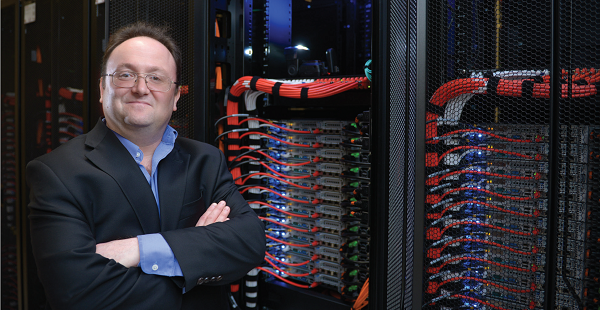
Henry Neeman is the Research Computing Director, Chief Research IT Officer and director of the OU Supercomputing Center for Education and Research (OSCER) at the University of Oklahoma. He has spent more than a decade developing training programs for research computing professionals. Stephanie Heidemann spoke with Henry about his Virtual Residency workshop series: an annual online workshop that trains cyberinfrastructure facilitators and research computing professionals through talks, panels, and hands-on practice in supporting researchers and their computing needs, and the broader leadership pipeline that it’s grown into.
How did the Virtual Residency get started?
In the early 2000s, Henry wrote a grant proposal to the U.S. National Science Foundation (NSF) to create an educational curriculum in research computing leadership. It was a $3M proposal to create a Ph.D.-level graduate certificate to provide guidelines on how to become a research computing leader. At the time, there was an urgent need for expanding the pool of research computing professionals. While he submitted the proposal three different times and revised several different iterations, his proposal was rejected multiple times. However, in 2014, the NSF added a Campus Cyberinfrastructure program to fund Campus Cyberinfrastructure (CI) Engineer positions, funding non-researcher positions for two years. So, in his proposal, Henry added the creation of a national program to train research computing facilitators and his final proposal was accepted.
Henry formed a team to put the program together internally at University of Oklahoma (OU). They used local speakers and brought in some speakers from outside of OU and designed the program from the ground up.
The content has changed over time, as researchers’ needs have changed, and as technology has continued to grow. Starting with about 50 registrants, the following year, it doubled. They recently completed their twelfth workshop. Over the life of the program, they have served more than 2,000 participants from over 560 institutions across all fifty states and roughly twenty countries on every continent, except Antarctica! Workshop participants engage in monthly calls to help pave the way for the design of the next workshop, based on their feedback and input.
What does the workshop look like?
A typical workshop runs four and a half days—four full days with two sessions each morning and afternoon, plus a half-day Friday. The community designs the workshops. Each year Henry sends out a poll listing all past topics, plus requesting new content suggestions.
Who is the Virtual Residency for?
The Virtual Residency is designed to help participants learn how to think. It offers different perspectives, from system administrators, data librarians, Research Software Engineers (RSE), and center directors, all in the same room to learn from each other to help improve research computing, across the globe.
For example, a researcher may be struggling with their workflow in the cluster. A system administrator might see a resource problem and try to fix the bottleneck. A data librarian looks at how the data is organized. An RSE sees a code problem and rewrites it. A center director may see something broader: how many other researchers have hit this same wall, and whether the center has the staffing to help them all before it becomes a larger institutional issue.
Each viewpoint, alone, produces only a partial fix. But when these roles share a room, they catch each other’s blind spots. That’s the idea behind Neeman’s “Level 3” workshop welcoming all of these roles: they support researchers better when they understand each other’s language and constraints, rather than working in separate silos, each seeing only their piece of the problem.
What are the course offerings within the Virtual Residency?
What began as a single workshop has grown into a five-level pipeline:
- Levels 1 and 2 are the Introductory & Intermediate Virtual Residency workshops.
- Level 3 – the Becoming an Institution-level Cyberinfrastructure Leader workshop is open to any research computing professional, not just facilitators.
- Levels 4 and 5 – the CI Leadership Academy addresses institution-level and national-level research computing leadership. This workshop series captures the expertise of senior national leaders before they retire, ensures succession planning, and preservation of history and knowledge.
What is the focus—technical skills or something else?
Mostly the latter. Teaching someone to be a system administrator is primarily technical, and there are plenty of programs that already do that well. Teaching someone to help researchers use computing is a different challenge entirely. It entails professional, interpersonal, and soft-skills work. We do not have time to teach people how to do things; we teach people how to think about things as a mentor, so they can figure out the rest, have productive conversations with peers.
One of our sessions that captures this well is the intake interview practicum where participants conduct rapid interviews with real researchers—people actually running jobs on machines—to identify their computing needs and offer actionable advice. Henry’s team prepares participants with a preparatory session the day before, including three simulated-intake interviews: two done well and one done very badly. In the practicum, experienced facilitators observe and judge whether participants earn a badge of achievement.
How are research computing leaders supported after completing a Virtual Residency training?
The Virtual Residency program has provided apprenticeships on writing grant proposals, writing papers, and running grants.
Why does this training matter so much right now?
Research computing is becoming more complex, and the learning curve for researchers keeps getting steeper. At the same time, more disciplines than ever depend on it — including newer entrants like the humanities, where research computing is still an emerging practice. As a result, RCD (Research Computing and Data) professionals are needed like never before. Facilitators serve as the bridge between researchers and systems that operate nothing like anything they encounter in daily life. Demand is growing, but there simply aren’t enough trained people to meet it.
The Virtual Residency is free to attend. For information on upcoming workshops and mailing list sign-up, contact the University of Oklahoma’s Supercomputing Center or visit the CaRCC People Network.