
Voting is now open for the 2026 CaRCC Contributor of the Year award. This annual award recognizes an individual who has made exceptional contributions to CaRCC over the past year through leadership, service, and dedication to advancing the research computing and data (RCD) community. Whether through working group leadership, mentoring, event organizing, or community building, each nominee has strengthened CaRCC’s mission and impact in meaningful ways.
We’re honored to present six outstanding candidates, each nominated by their CaRCC colleagues for the significant ways they’ve contributed to our community. Read about their achievements below, then cast your vote for the person you believe made the greatest impact helping CaRCC in 2026. Voting closes Monday, December 7, and the winner will be announced Thursday, December 10, 2026. Good luck choosing just one! (Voting is anonymous.)
Meet the Nominees:

Brian Haymore: Senior IT Architect & Manager, HPC, University of Utah
A True CaRCC Evangelist and Connector of People
Brian Haymore is a long-time CaRCC contributor whose work spans the Systems-Facing Track, website hosting coordination, and ongoing workforce development groups with an emphasis on student development. Colleagues describe him as a frequent voice of reason and as someone who is core to the community aspect of CaRCC. Brian is also one of CaRCC’s most enthusiastic ambassadors. While co-chairing the PEARC26 Student program, he consistently spoke about the value of CaRCC and the RCD community, explaining how the different tracks help professionals share knowledge and learn from one another. He highlighted ways to support students through mentorship, engagement, and pathways into research computing. He also listened to the ideas of his co-chair and built them into the planning, creating an environment where people are heard. As one nominating colleague notes, Brian is “a face of CaRCC that brings people into our community.” Kind, friendly, and approachable despite being in high demand, he connects people with the resources and opportunities that move CaRCC’s initiatives forward. His warmth and commitment make him a fitting candidate for this award. Learn more about Brian on LinkedIn

Betsy Hillery: Director of Data Initiatives, The Lilly Purdue Innovation Institute
A Tireless Advocate for RCD Professionals and the Students Who Will Join Them
Betsy Hillery has been a champion for the RCD workforce across CaRCC for many years. Her past roles have included: Co-Chair of the Systems-Facing Track and Co-Chair of the Mentoring Working Group; she also supported the launch of/was Co-Chair of the Student Engagement Working Group, building on her legacy of championing students through CaRCC, PEARC, and SC. Currently, as Co-Chair for the Workforce Development Interest Group, she finds timely topics and speakers that help develop the RCD professions. She also volunteers regularly to plan and run RCD Nexus Day. This year, Betsy responded to community interest by spearheading a new microcredentials group, bringing together people who want to explore how to offer microcredentials that recognize RCD skills. As one nominating colleague notes, Betsy “has been a tireless advocate for CaRCC, for RCD professionals, and especially for students exploring RCD.” Another adds that she “has made so many contributions with regard to the Workforce Development interest group.” Her knack for turning community interest into action makes her a fitting candidate for this award. Learn more about Betsy on LinkedIn
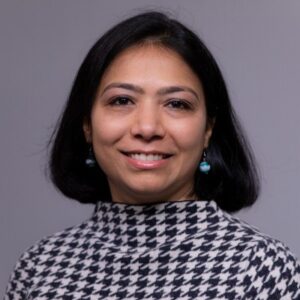
Manasvita Joshi: Senior Director, Harvard Faculty of Arts & Sciences Research Computing (FASRC)
A Visible Voice for CaRCC’s Products and the Power of Shared Problem-Solving
Manasvita Joshi has quickly become a highly dedicated and productive member of CaRCC leadership. She promotes the community’s products and shows their value by bringing RCD professionals together to tackle shared problems. As co-chairs of both the Anaconda Transition Working Group and the AI Facilitation Materials Working Group, Manasvita has directly contributed to two of CaRCC’s primary products this year: the Anaconda transition white paper and the AI Facilitation Handbook. Both respond to community demand for shared guidance. She hasn’t stopped at creating these resources. Manasvita has steadily promoted them by presenting the groups’ findings at PEARC and on community calls, helping the work reach the people who need it. As one nominating colleague notes, she is “one of the most visible and prolific faces promoting CaRCC’s products to the community.” Her energy for turning collaboration into practical resources makes her a fitting candidate for this award. Learn more about Manasvita on LinkedIn

Tom Marcais: Research Computing Administrator, Information Technology Services, Washington and Lee University
A Vocal Champion for Smaller Institutions in the RCD Space
Tom Marcais is a CaRCC leader who has become an active and vocal presence for smaller institutions in the national research computing and data space. His current role is Co-Coordinator of the Smaller Institutions & Programs (SIP) Track, which he helped create by refocusing and renaming the former Emerging Centers Track, giving those campuses a clearer home in the community. He has also helped inform CaRCC’s overall non-R1 engagement strategy and activities, allowing CaRCC to better serve our members from smaller institutions and programs. He is also a founding member of the Quantum Interest Group and remains actively involved in that effort, helping the CaRCC community learn about and explore this emerging area of RCD. As one nominating colleague notes, Tom “was instrumental in getting the Quantum Interest Group running.” His advocacy and leadership makes him a fitting candidate for this award. Learn more about Tom on LinkedIn

Ashley Stauffer: Associate Director of Solution Alignment, Penn State University Office of Research Information Systems and Solutions (ORISS)
A Dedicated Leader Who Turns Data into Community Insight
Ashley Stauffer, MS, PMP, has been a steady presence in CaRCC since 2020. She has co-chaired the RCD Professionalization Working Group since 2023, and she is a former member of the Financial Models Working Group, where she reviewed non-profit structures to inform CaRCC’s transition to a 501(c)(3). This year, Ashley led the development of the most recent RCD Workforce Survey, which drew 818 unique responses and resulted in a conference paper at PEARC26 on the characteristics, complexities, and challenges of RCD work and facilitation. The survey gives the community critical data that benefits everyone in CaRCC and the wider RCD field. She also volunteered to present the results at this year’s RCD Nexus Day Onramps to RCD workshop, where her presentation was integral to the event’s quality and success. As one nominating colleague says, Ashley is “a joy to know and an invaluable asset to the CaRCC Community!” Her rigor, generosity, and skill make her a fitting candidate for this award.
Learn more about Ashley on LinkedIn

Michael Weiner: Senior Research Scientist and AI Makerspace Technology & Engagement Strategist, Georgia Institute of Technology
A Humble Servant-Leader Who Builds Resources for the Whole Community
Michael Weiner does a great deal for the RCD community, and colleagues say he would be the last person to brag about it. As Co-Chair of the Workforce Development Interest Group, Michael’s leadership has helped produce tools and resources that benefit all CaRCC members, and beyond. Michael is a generous contributor of his time and energy. He makes thoughtful suggestions and is proactive in seeking ways to strengthen CaRCC. Despite being both brilliant and busy, he is friendly, welcoming, patient, and supportive of his fellow community members, and always happy to roll up his sleeves when things need to get done. As one nominating colleague puts it, Michael is “the very definition of a servant-leader, and CaRCC is lucky to have him!” His humility and steady commitment to the community make him a fitting candidate for this award. Learn more about Michael on LinkedIn
Your vote is anonymous.